
Why Everything Feels Like Gambling
Robinhood released its Q2 earnings last week. I don’t use Robinhood; I don’t own Robinhood equity, and I don’t have any reason to care about the company, except that one stat in particular caught my attention: Robinhood — a retail trading platform built on the promise of “democratizing finance for all” — now generates more transaction revenue from prediction markets than from equity trading. In fact, only 17% of Robinhood’s transaction-based revenue last quarter came from equity trading, with 83% coming from options, crypto, and prediction markets.
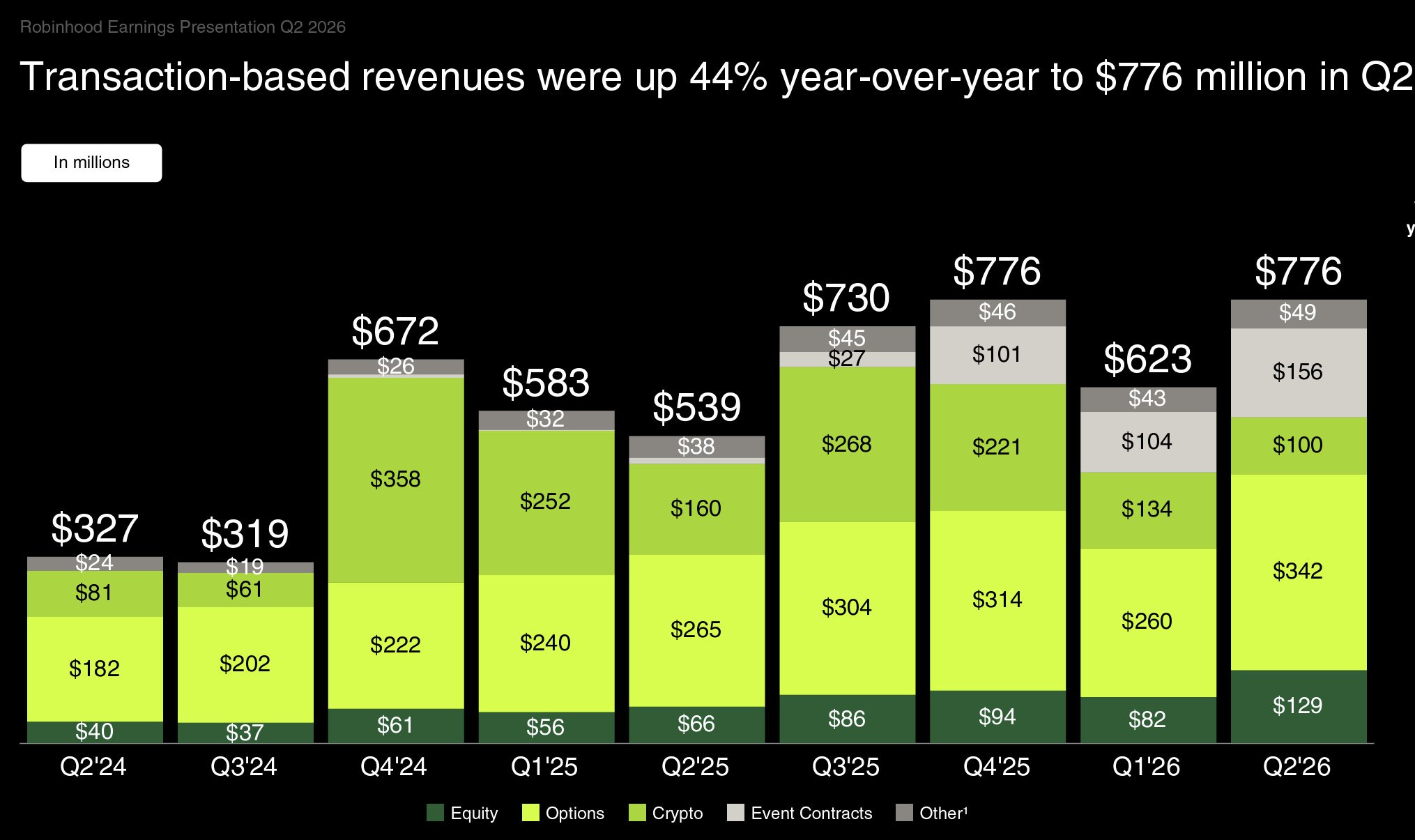
This is an alarming stat because it means Robinhood and its customers have misaligned incentives. Buying equity in good companies and holding it for a long period of time has always been the best and safest way for the middle class to build wealth, but since Robinhood earns virtually zero margin on equity trading, customers are now being pushed into riskier products, such as options and prediction markets. Those products may offer quicker and more aggressive returns, but they also carry significantly more risk compared to equity trading.
To be clear, this is not just a Robinhood problem. It feels like every part of the economy has been overindexed toward gambling. The legalization of sports betting and prediction markets is the most obvious example, but national lottery ticket sales have doubled over the last few years, and Reddit is full of retail traders buying options contracts that expire within hours or chasing extreme short-term spikes in volatile equities or crypto tokens based solely on social media sentiment.
Most people will tell you this behavior has a simple explanation: young adults have been crushed by inflation, and with housing prices heavily outpacing wage growth, they feel like the American dream is out of reach. They see no path to affording a home and starting a family, so they gamble for the moonshot outcome.
But what if the explanation is even simpler than that? As a relatively new parent with three young kids, I find myself spending a lot of time thinking about how society has changed and how it might continue to change in the future. And while I will concede that housing affordability remains historically stretched (and that the median age of a first-time homebuyer has climbed dramatically over the last decade), I actually think those issues are the accelerant, not the fire itself.
The old way to build wealth was simple. You get a job, save money, buy a house, own stocks, and wait for the results to pay off. That model wasn’t perfect, but it taught people that time was their greatest asset. However, today, nearly every major consumer platform makes more money when you do something, not wait.
There are plenty of wealthy people gambling on sports. The average investor trading options on Robinhood isn’t necessarily broke. Crypto speculation isn’t confined to low-income households, and prediction markets are full of software engineers, lawyers, entrepreneurs, and other well-educated, high-income earners.
That tells me something else is happening. Rather than blaming the problem on people feeling poor, what if the real issue is that people feel late? Or, in other words, I’m talking about the difference between someone saying “I don’t have enough” and “everyone else seems to be getting rich faster than I am.”
Social media has completely changed the reference point. Thirty years ago, you compared yourself to your neighbors. What kind of car did they have? Where did they go on vacation? Did their kids have the nicest sports equipment? The results varied, but since people within the same tax bracket usually buy homes in the same neighborhoods, it felt like you were generally on pace with everyone else.
But now that social media has become a big part of everyone’s lives, the ability to compare lifestyles has expanded. Rather than just looking at how your neighbors or people within your community were doing financially, you’re now being shown the guy who turned $10,000 into $10 million by buying a random crypto token, the entrepreneur who sold his business for $500 million at the age of 28, the athlete signing a $700 million contract, and the sports betting guru selling vulnerable teens on their “zero-risk systems” by showing off exotic cars and luxury houses.
What you don’t see on social media are the millions of people quietly maxing out their retirement accounts. You don’t see the W-2 employee saving a few hundred dollars each month for investments. That’s because social media only shows the winners. As a result, our expectations have become warped. And it doesn’t take a genius to realize that people who perceive themselves as doing worse than their peers are more likely to partake in low-probability, high-payoff “investments.”
There’s a reason the phrase “comparison is the thief of joy” is so popular. But I also think moving the reference point is only part of the larger problem.
The secondary issue is the business model. Rather than incentivizing assets to grow, the new financial system increasingly makes money from decisions. Think about Robinhood. Someone who automatically invests a portion of their paycheck in the S&P 500 and doesn’t touch it for two decades is an excellent investor, but that investor is worth very little to Robinhood as a customer. Instead, Robinhood wants customers who trade options every week, buy crypto based on a friend's recommendation, and trade election market contracts. Those customers open the app 5x per day and constantly make decisions, driving transaction fees higher.
This is why everything feels like a casino. Rather than building a product that enables people to save, invest, and hold, Robinhood’s product team has optimized for engagement, retention, daily active users, and transaction volumes. The former is better for customers; the latter is better for Robinhood’s shareholders.
So what can you do about this? Well, I can tell you what I plan on doing with my kids. I plan on teaching them the power of compounding. I plan on showing them the difference between investing and entertainment. I plan to add friction so that they cannot easily access gambling apps or lines of credit. I plan to teach them the math on probabilities, the house edge, survivorship bias, and why social media only shows winners. I don’t want my kids to be afraid of risk, but I do feel that it is my responsibility to teach them the difference between investing in productive assets and putting their money in something engineered to keep them playing.
If you enjoyed today’s newsletter, share it with a friend.